
There is a particular kind of exhaustion that millions of women know intimately but rarely talk about out loud. It is the bone-deep tiredness that arrives in the days before a period — the kind where you crawl into bed early, desperate for rest, only to lie awake staring at the ceiling at 2 a.m., too hot, too anxious, too uncomfortable to drift off. Then, a week or two later, you sleep like a stone and wonder what all the fuss was about. If this rhythm sounds familiar, you are not imagining it, and you are certainly not broken. You are experiencing one of the most under-discussed truths of female physiology: your menstrual cycle and your sleep are deeply, biologically intertwined.
For decades, sleep science was built largely on the bodies and brains of men. Researchers actively avoided studying women because our fluctuating hormones were considered an inconvenient variable — something that “messed up” the clean data. The irony is staggering. Those very fluctuations are precisely what we needed to understand. Today, in 2026, we finally have a richer picture of how the hormonal tides of the menstrual cycle ripple through every night of sleep, and what we can do about it.
This guide is a deep, warm, practical walk through that science. We will explore how estrogen and progesterone influence your brain, your body temperature, and your internal clock; how your sleep predictably shifts across the four phases of your cycle; why the week before your period can feel like a special form of sleep sabotage; and how the relationship runs both ways — poor sleep making your hormones and your mood worse, in a loop that can feel impossible to escape. We will talk about PCOS, perimenopause, pregnancy, and the postpartum fog. And we will get specific about what actually helps, phase by phase, so you can stop fighting your biology and start working with it.
A woman sleeping peacefully in bed
A quick, honest note before we begin: this article is general educational information, not medical advice. It is meant to help you understand your body and have smarter conversations — with yourself, with a partner, and with your doctor. It is not a substitute for personalized care. With that said, let’s get into it.
The Hidden Conductor: How Hormones Run Your Sleep
To understand why your sleep changes across the month, you first have to meet the two hormones doing most of the orchestrating: estrogen and progesterone. These are not abstract chemicals that live only in textbooks and reproductive biology classes. They are powerful neuroactive substances that cross into your brain and touch the very systems that govern when you feel sleepy, how deeply you rest, and whether you wake up restored or wrecked.
Estrogen: The Energizing, Sleep-Protecting Hormone
Estrogen, particularly the form called estradiol, is often thought of purely as a “reproductive” hormone. In reality, it acts almost like a natural performance enhancer for your nervous system. Estrogen has a hand in regulating serotonin, dopamine, acetylcholine, and norepinephrine — the neurotransmitters that influence mood, alertness, motivation, and the architecture of sleep itself.
When estrogen is rising and abundant, most women experience sleep that is more efficient and more consolidated. Estrogen tends to increase the amount of REM sleep (the dream-rich stage tied to memory and emotional processing) and can reduce the time it takes to fall asleep. It also has a subtle protective effect on the body’s core temperature regulation, helping keep nighttime body temperature in the cool, sleep-friendly zone. In short, when estrogen is high and rising, your brain and body are primed for the kind of deep, restorative rest that leaves you genuinely refreshed.
This is why, for many women, the days following the end of a period — the early to mid follicular phase — quietly become the best sleep of the month. You may not even notice it, because good sleep tends to be invisible. It is only when sleep goes wrong that we sit up and pay attention.
Progesterone: The Double-Edged Sedative
Progesterone is the more complicated character in this story. After ovulation, progesterone rises sharply, and it has a famously sedating, calming quality. This is because progesterone is metabolized into a compound called allopregnanolone, which acts on the brain’s GABA receptors — the same receptors targeted by anti-anxiety medications and sleep aids. In theory, this should make you sleepy and relaxed. And early in the luteal phase, it often does: many women feel a pleasant heaviness and find themselves yawning by mid-evening.
But progesterone is a double-edged sword. While it can promote sleepiness, it also raises your core body temperature by roughly 0.3 to 0.5 degrees Celsius (about half a degree to a full degree Fahrenheit). And here is the catch: your body needs to cool down to fall asleep and stay asleep. A warmer core temperature works directly against the natural nighttime temperature drop that triggers deep sleep. So even as progesterone is whispering “relax,” it is also nudging your thermostat up in a way that can fragment your rest.
Then, in the days right before your period, progesterone plummets. That sudden withdrawal of the calming, GABA-soothing effect can leave the nervous system feeling jangly and overstimulated — a hormonal equivalent of withdrawal. For many women, this is the precise moment when sleep falls apart.
The Circadian Rhythm Connection
Your sleep is governed not only by hormones but by your circadian rhythm — the roughly 24-hour internal clock that tells your body when to be alert and when to wind down. This clock is itself responsive to estrogen and progesterone. Research suggests that the menstrual cycle can subtly shift the timing and strength of circadian signals, including the nightly release of melatonin, the hormone of darkness and sleep.
When your reproductive hormones and your circadian rhythm are in harmony, sleep feels effortless. When they fall out of sync — as they do during the hormonal turbulence of the late luteal phase — your body can feel like it is being asked to sleep and wake on two conflicting schedules at once. Understanding this interplay is the first step toward reclaiming your nights, and it is exactly the kind of pattern that becomes visible when you start tracking. A thoughtful, modern Period Tracker App lets you log sleep quality right alongside your cycle so these connections stop being a mystery and start being something you can plan around.
Sleep Across the Four Phases of Your Cycle
The menstrual cycle is commonly divided into four phases: menstruation, the follicular phase, ovulation, and the luteal phase. Each has its own hormonal signature, and each tends to bring a characteristic flavor of sleep. No two women are identical, and your personal pattern may differ — which is exactly why tracking matters — but the general arc is remarkably consistent across the research.
Phase One: Menstruation — Sleep During Your Period
The period itself, the bleeding phase, is a study in contrasts. On one hand, both estrogen and progesterone are at their lowest, which removes the temperature-raising effect of progesterone and can make the sleep environment more comfortable. Many women find that once their period actually starts, the worst of the pre-period insomnia begins to ease, almost as if the body finally exhales.
On the other hand, menstruation brings its own sleep disruptors. Cramps (dysmenorrhea) can be genuinely painful and make it hard to find a comfortable position. Heavy flow may mean getting up in the night to change protection, fragmenting sleep. Headaches, bloating, and lower-back ache all add friction. And for some women, the drop in iron from blood loss can contribute to restless legs or daytime fatigue that throws off the whole sleep-wake rhythm.
So menstruation is paradoxical: hormonally it can be a relief, but physically it can be uncomfortable. The good news is that period-related sleep problems are often very responsive to practical strategies — warmth, pain management, magnesium, and the right sleep setup — which we will cover in detail later.
Phase Two: The Follicular Phase — Your Sleep Sweet Spot
After your period ends, you enter the follicular phase, and for many women this is the golden window of sleep. Estrogen begins its steady climb, and with it often comes better mood, more energy, sharper focus, and — crucially — deeper, more efficient sleep. Body temperature is in its lower range, the nervous system is calm but not sedated, and the brain enjoys plenty of restorative slow-wave and REM sleep.
This is the time of the month when you may find you need slightly less sleep to feel great, when you bounce out of bed more easily, and when late nights cost you less. If you have ever wondered why some weeks you feel unstoppable and others you feel like you are wading through wet sand, the follicular phase is a big part of the answer. Tracking reveals this beautifully: when you can see your best-sleep week laid out next to your cycle, you can deliberately schedule demanding work, travel, or social events for the times your body is best equipped to handle them.
Phase Three: Ovulation — A Brief Hormonal Peak
Around the middle of your cycle, ovulation occurs, marked by a surge in luteinizing hormone and a peak in estrogen. For most women, sleep around ovulation remains good, riding the tail of that estrogen high. Some women feel a burst of energy, libido, and confidence — the body’s reproductive prime time.
However, a minority of women notice the first subtle shifts here. As estrogen peaks and then begins to dip, and as progesterone starts to rise post-ovulation, body temperature begins its upward climb. If you track your basal body temperature, you can actually see this shift: a small but distinct rise that marks the transition from the follicular to the luteal phase. This temperature change is the opening note of a song that, for many women, ends in the rough sleep of the premenstrual days.
Phase Four: The Luteal Phase — Where Sleep Gets Complicated
The luteal phase, the roughly two weeks between ovulation and your next period, is where the sleep story gets genuinely complicated — and where most cycle-related sleep complaints cluster. Early in the luteal phase, progesterone’s sedating effect may actually make you feel sleepy and calm. But as the phase progresses and you approach your period, both estrogen and progesterone fall, often steeply, and the nervous system is left without its hormonal cushioning.
This late luteal phase is when premenstrual insomnia, night sweats, anxiety-driven wakefulness, and fragmented sleep tend to peak. It is the week that sends so many women searching for answers at 3 a.m., phone in hand, wondering why they cannot sleep when they are so very tired. It deserves its own dedicated section, because understanding it is genuinely empowering.
A woman awake at night by lamplight

Why the Week Before Your Period Wrecks Your Sleep
If you take away one thing from this article, let it be this: the terrible sleep so many women experience in the days before their period is real, it is physiological, and it is not a personal failing. There is a confluence of factors working against you in that late luteal week, and naming them takes away some of their power.
The Hormone Withdrawal Effect
We touched on this above, but it bears repeating because it is the heart of the matter. Throughout the luteal phase, your brain has been bathed in progesterone and its calming metabolite allopregnanolone, which soothes the GABA system. In the days before your period, progesterone withdraws sharply. Your nervous system, accustomed to that calming influence, can become hyper-aroused in its sudden absence — restless, edgy, and primed to wake at the smallest disturbance. It is, in a real sense, a mild withdrawal state, and it directly undermines your ability to fall and stay asleep.
The Temperature Rise
That progesterone-driven elevation in core body temperature lingers into the late luteal phase before dropping when your period begins. A warmer body resists the cooling it needs for deep sleep. This is why so many women report feeling uncomfortably warm in bed, kicking off the covers, or waking drenched in the premenstrual week. Night sweats are not only a perimenopause phenomenon — they are a regular feature of the late luteal phase for a great many cycling women, and the temperature mechanism is largely to blame.
Premenstrual Anxiety and Mood Changes
The hormonal shifts of the late luteal phase do not just affect temperature; they affect mood. Falling estrogen means falling serotonin support, which can translate into irritability, low mood, tearfulness, and anxiety. And anxiety is one of sleep’s great enemies. A racing, worried mind at bedtime activates the stress response, raises cortisol, and keeps you wired when you most want to be calm. For women with premenstrual dysphoric disorder (PMDD), a severe form of premenstrual mood disturbance, this effect can be profound and genuinely disabling, and it absolutely warrants medical support.
Physical Discomfort
Bloating, breast tenderness, headaches, and the early twinges of cramps all add a layer of physical discomfort that makes it harder to settle. When your body is uncomfortable and your mind is anxious and your core temperature is up and your nervous system is in mild withdrawal, it is no wonder that the week before your period can feel like a perfect storm for insomnia.
Putting It Together
Here is the empowering part. Once you understand that this rough patch is predictable and hormonal, you can prepare for it. You can pre-load good sleep hygiene, adjust your environment, plan lighter commitments, and lean on calming routines before the storm arrives rather than scrambling in the middle of it. This is precisely where tracking transforms a recurring ambush into a manageable, anticipated season of the month. When your tracker can predict your rough nights a few days out, you get to meet them ready instead of blindsided.
The Two-Way Street: How Poor Sleep Worsens Your Hormones
So far we have talked about how your cycle affects your sleep. But the relationship is bidirectional — a two-way street — and this is one of the most important and least appreciated facts in women’s health. Poor sleep does not just result from hormonal changes; it actively makes hormonal and mood symptoms worse, creating a vicious cycle that can spiral if left unaddressed.
Sleep and the Stress Response
When you sleep badly, your body produces more cortisol, the primary stress hormone. Elevated cortisol disrupts the delicate balance of reproductive hormones and can throw off the timing and intensity of your cycle. Chronic sleep deprivation has been linked to more irregular cycles, more severe PMS, and worse premenstrual mood symptoms. In other words, the bad sleep of your luteal phase can make your luteal phase symptoms even worse — a feedback loop that feeds on itself.
Sleep, Appetite, and Cravings
Poor sleep also disrupts the hormones that regulate appetite — ghrelin and leptin — leaving you hungrier and more drawn to sugary, high-carbohydrate, high-fat foods. This compounds the cravings that already tend to spike in the luteal phase. The result is that under-slept premenstrual days often come with stronger cravings, blood-sugar swings, and the energy crashes that follow, all of which further degrade mood and sleep. It is a tangle, and food is one of the threads you can actually pull on, which is why cycle-aware nutrition matters so much.
Sleep and Emotional Regulation
REM sleep, which estrogen helps protect, is the brain’s overnight therapist — it processes emotional experiences and dampens the reactivity of the amygdala, the brain’s alarm center. When you lose sleep, especially REM sleep, your emotional resilience drops. Small stressors feel bigger. Irritability rises. The premenstrual mood dip becomes a mood crash. So the sleep you lose in the late luteal phase directly erodes your capacity to cope with the very symptoms that phase brings.
Breaking the Cycle
The encouraging news is that because the loop runs both ways, intervening at any point can help. Improve your sleep, and you often improve your mood, your cravings, and even the regularity and comfort of your cycle. This is why prioritizing sleep is not a luxury or an indulgence for women — it is foundational hormonal health. And the first step to improving sleep is understanding your own personal pattern, which brings us to the case for tracking. Resources like vyvecare exist precisely to help women see and interrupt these loops rather than suffer through them silently.
When Hormones Get Complicated: PCOS, Perimenopause, Pregnancy, and Postpartum
The cycle-sleep relationship we have described is the “baseline” pattern for women with relatively regular cycles. But life and physiology bring complexity, and several common conditions and life stages reshape the sleep landscape considerably. Understanding these can help you make sense of your own experience or support someone you love.
Sleep and PCOS
Polycystic ovary syndrome (PCOS) affects a significant proportion of women of reproductive age and brings a distinct set of sleep challenges. Women with PCOS have a markedly higher risk of obstructive sleep apnea — a condition where breathing repeatedly pauses during sleep — even at lower body weights than you might expect. The hormonal features of PCOS, including elevated androgens and frequent insulin resistance, appear to independently increase sleep apnea risk.
Beyond apnea, the irregular and often anovulatory cycles of PCOS mean the predictable hormonal rhythm is disrupted, so the usual phase-based sleep patterns may be muted or chaotic. Insulin resistance can drive blood-sugar swings that disturb sleep, and the higher rates of anxiety and depression associated with PCOS add another layer. If you have PCOS and struggle with snoring, daytime sleepiness, or unrefreshing sleep, a conversation with your doctor about screening for sleep apnea is genuinely worthwhile. Tracking sleep and symptoms over time can give your clinician valuable data to work with.
Sleep in Perimenopause
Perimenopause — the years of hormonal transition leading up to menopause, often beginning in the early-to-mid forties — is arguably the most disruptive chapter for women’s sleep. As estrogen and progesterone fluctuate wildly and then decline, sleep can become deeply fragmented. The hallmark hot flashes and night sweats are themselves often triggered by the narrowing of the body’s temperature-regulation window, and a night sweat is a near-guaranteed way to be jolted awake.
Perimenopausal women frequently report a new and unwelcome pattern: falling asleep fine but waking in the small hours and being unable to return to sleep. Declining progesterone removes its sedative support, declining estrogen disrupts serotonin and temperature regulation, and rising rates of anxiety and mood changes pile on. Sleep apnea risk also rises as estrogen — which is somewhat protective of the airway — declines. For women in this stage, tracking cycle changes alongside sleep and symptoms is invaluable, both for self-understanding and for productive medical conversations about options. Tools like vyvecare increasingly support women through this transition, not just the reproductive years.
Sleep in Pregnancy
Pregnancy transforms sleep across all three trimesters, and the changes are driven by the dramatic hormonal shifts of gestation. In the first trimester, soaring progesterone often brings overwhelming daytime sleepiness, even as frequent urination and nausea fragment nighttime sleep. The second trimester is frequently the most comfortable, with many women sleeping reasonably well. The third trimester brings physical discomfort, heartburn, leg cramps, restless legs syndrome, frequent urination, and the sheer difficulty of finding a comfortable position, all of which conspire against rest. Sleep-disordered breathing can also emerge or worsen in later pregnancy. Pregnancy sleep is a topic worthy of its own care, and pregnant women should always work with their healthcare providers on any persistent sleep concerns.
Sleep Postpartum
The postpartum period is, famously, a season of profound sleep disruption — driven not only by a newborn’s feeding schedule but by the abrupt hormonal cliff that follows childbirth. Estrogen and progesterone plummet within days of delivery, a hormonal shift more dramatic than anything in the normal cycle, and this contributes to mood vulnerability and disrupted sleep architecture. Sleep deprivation in the postpartum period is a serious matter, closely linked with postpartum depression and anxiety. New mothers deserve real support, rest where they can find it, and prompt medical attention if mood symptoms become severe. This is a stage where reaching out for help is a sign of strength, not weakness.
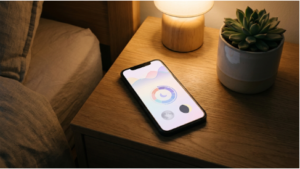
A phone showing a sleep and cycle dashboard on a nightstand
Why Tracking Sleep Alongside Your Cycle Changes Everything
Here is the quiet revolution at the heart of this entire conversation: when you track your sleep and your cycle together, the invisible becomes visible. Patterns that felt random and frustrating suddenly resolve into a clear, predictable rhythm. And once you can see the pattern, you can plan around it — which is the difference between being at the mercy of your hormones and working in partnership with them.
From Random to Predictable
Most women experience their cycle-sleep patterns as a series of disconnected, baffling events. One week you sleep beautifully; another week you are wide awake at 3 a.m. for no apparent reason. Without tracking, there is no thread connecting these experiences, so they feel chaotic. But when you log your sleep quality, your symptoms, your mood, and your energy alongside your cycle day, the thread appears. You begin to see, in black and white, that your worst sleep reliably clusters in the same few days each month. That recognition alone is enormously reassuring — it transforms “What is wrong with me?” into “Ah, this is my late luteal week again, and I know what to do.”
Your Pattern Is Unique
While the general arc we have described holds true for most women, the specifics are deeply individual. Some women hit their rough patch five days before their period; others two days before. Some sleep best in the early follicular phase; others peak around ovulation. Some get night sweats; others get anxiety-driven wakefulness; others get cramp-related disruption. There is no substitute for your own data, gathered over a few cycles, to reveal your pattern. This is where a smart, well-designed tracker earns its place on your phone. The best period tracker is the one that lets you log not just bleeding days but the full picture — sleep, mood, energy, symptoms — so your personal pattern can emerge.
Planning Around Your Pattern
Once you know your pattern, you gain a kind of superpower: foresight. You can schedule the big presentation or the long-haul flight for your follicular sweet spot. You can pre-emptively dial up your sleep hygiene a few days before your known rough patch, rather than scrambling once insomnia has already set in. You can warn a partner that the next few nights might be restless, plan lighter social commitments, stock up on magnesium-rich foods, and prepare your bedroom to be extra cool. Tracking turns the late luteal storm from an ambush into a forecast—and a forecast you can prepare for.
How the Vyve App Brings This Together
This is exactly the problem the Vyve app was designed to solve, and it is worth describing how, because the right tool genuinely changes the experience. Vyve is a privacy-first cycle and wellness companion built around the idea that your data should reveal your patterns and stay yours.
At its core, Vyve offers rich symptom and mood tracking that goes well beyond the bleeding calendar. You can log sleep quality and energy levels each day, alongside mood, cramps, cravings, and dozens of other symptoms, so the cycle-sleep connection we have been discussing becomes visible in your own life. Over a few cycles, the app’s AI predictions learn your rhythm and begin to anticipate your rough nights — gently flagging, a few days ahead, when your historically poor-sleep window is approaching, so you can prepare instead of being caught off guard.
Vyve also includes an AI Cycle Coach, a knowledgeable, judgment-free companion you can ask about what is happening in your body and what might help tonight. Rather than sending you down a rabbit hole of contradictory internet searches at 2 a.m., the coach offers grounded, personalized guidance based on where you are in your cycle. And because nutrition and rest are so tightly linked, Vyve provides cycle-synced food and nutrition suggestions — the kind of magnesium-rich, blood-sugar-steadying, sleep-supporting foods that are especially valuable in the luteal phase, recommended at the right time in your cycle.
Crucially, Vyve is built privacy-first. Your intimate health data is among the most sensitive information you have, and Vyve treats it that way. For women who have grown wary of apps that monetize their reproductive data, this matters enormously. You can explore the full philosophy and feature set at vyvecare, and if you are ready to start seeing your own pattern, the Period Tracker App is available to download and begin tracking tonight.
The point is not the technology for its own sake. The point is that a thoughtful tracker turns the abstract science in this article into concrete, personal, actionable knowledge about your own body. That is the whole game.
Phase-by-Phase Sleep Strategies That Actually Work
Now for the practical heart of this guide. Understanding the science is empowering, but you came here for things you can actually do. Below are general, evidence-informed sleep-hygiene and nutrition strategies organized by cycle phase. None of this is a substitute for medical advice, and what works varies from woman to woman — but these are sensible, low-risk starting points that help many people sleep better.
Foundational Sleep Hygiene for Every Phase
Before we get phase-specific, there are universal principles that support good sleep at any point in your cycle. Think of these as the foundation everything else is built on.
Keep a consistent sleep-wake schedule. Going to bed and waking at roughly the same times every day, even on weekends, anchors your circadian rhythm and makes every night of sleep more reliable. Consistency is arguably the single most powerful sleep habit.
Get bright light in the morning. Exposure to natural light within an hour of waking helps set your internal clock, boosts daytime alertness, and strengthens the nighttime melatonin signal. A short morning walk outdoors is one of the best things you can do for your sleep that night.
Dim the lights in the evening. In the hours before bed, reduce bright overhead lighting and especially the blue-rich light of screens. Light at night suppresses melatonin and tells your brain it is still daytime. Warm, dim lamps and a screen curfew (or at least night-mode and reduced brightness) help your body prepare for sleep.
Keep your bedroom cool, dark, and quiet. Since core body temperature needs to drop for sleep, a cool room — many sleep experts suggest somewhere around 18 degrees Celsius or 65 degrees Fahrenheit as a starting point — supports the process. Blackout curtains and, if needed, an eye mask and earplugs or a white-noise machine remove sleep-disrupting light and sound.
Mind your caffeine timing. Caffeine has a long half-life, meaning it lingers in your system for many hours. As a general rule, stopping caffeine by early afternoon (around six to eight hours before bed, and earlier if you are sensitive) protects your sleep. This becomes especially important in the luteal phase, when sleep is already fragile.
Be thoughtful about alcohol. Alcohol may make you feel sleepy at first, but it fragments sleep later in the night and suppresses restorative REM sleep. Reducing alcohol, particularly in the premenstrual week, often noticeably improves sleep quality.
Build a wind-down routine. A consistent, calming pre-sleep ritual — a warm bath or shower (which, counterintuitively, helps your core temperature drop afterward), gentle stretching, reading, journaling, or breathing exercises — signals to your nervous system that it is safe to let go.
Follicular Phase: Make the Most of Your Sleep Sweet Spot
In the follicular phase, when estrogen is rising and sleep tends to be at its best, your job is largely to protect and capitalize on a good thing. This is the time to build sleep momentum: lock in your consistent schedule, get plenty of morning light, and use your higher energy for exercise (which itself improves sleep) earlier in the day. Because your sleep is more resilient now, this is also the phase where the occasional late night or early start costs you the least — so if you must have disrupted nights, the follicular phase is when to schedule them. From a nutrition standpoint, this energetic phase pairs well with fresh, lighter, nutrient-dense foods, and your body generally handles a normal eating rhythm with ease.
Ovulation: Maintain Your Routine
Around ovulation, sleep usually remains good, so the strategy is simply to maintain your solid habits. Keep your schedule consistent, stay on top of light exposure, and be aware that for some women a slight temperature rise begins here — so if you notice the first hints of warmth at night, this is a good time to start cooling your bedroom a touch and easing off caffeine a little earlier in the day, in anticipation of the luteal phase ahead.
Luteal Phase: Prepare and Defend
The luteal phase, especially the late luteal premenstrual days, is where strategy matters most. This is the time to be proactive rather than reactive.
Cool things down aggressively. Since both progesterone and the premenstrual state raise your body temperature, lean into cooling. Lower the thermostat, switch to lighter, breathable bedding and sleepwear (natural fibers like cotton and linen breathe better), and consider a cooling mattress topper or pillow if night sweats are an issue. A cool room is your friend in this phase.
Front-load your caffeine and cut it off early. Your sleep is more fragile now, so be stricter about caffeine timing — consider stopping by late morning during the premenstrual days if you are sensitive.
Lean on magnesium-rich foods. Magnesium plays a role in muscle relaxation, nervous-system calming, and sleep regulation, and many women find it especially helpful premenstrually for both sleep and cramps. Magnesium-rich foods include leafy greens, pumpkin seeds, almonds, dark chocolate, beans, and whole grains. Cycle-synced nutrition tools, like those built into Vyve, can prompt you toward these foods at exactly the right time. (If you are considering a magnesium supplement, check with your doctor or pharmacist first, especially if you have any kidney issues or take other medications.)
Steady your blood sugar. Because cravings and blood-sugar swings spike in the luteal phase and can disturb sleep, aim for balanced meals with protein, healthy fats, and fiber, and be gentle with refined sugar — particularly in the evening. A blood-sugar crash in the night can wake you.
Manage premenstrual anxiety actively. Since anxiety is a major late-luteal sleep disruptor, this is the phase to double down on calming practices: extended wind-down routines, breathwork, gentle yoga, meditation, journaling to offload a racing mind, or a warm bath before bed. Treat your evening as sacred wind-down time during these days.
Address discomfort proactively. If cramps or aches are likely, plan ahead — a hot water bottle or heating pad, comfortable positioning, and discussing pain-management options with your doctor can all reduce the physical disruption to sleep.
During Your Period: Comfort and Care
Once your period begins, the hormonal storm often eases, but physical comfort becomes the priority. Continue the cooling and calming habits, use heat for cramps (a heating pad on the lower abdomen is genuinely soothing and many women find it helps them sleep), and protect your bedding so worry about leaks does not keep you on edge. Because blood loss can lower iron, focus on iron-rich foods (lean red meat, lentils, leafy greens, paired with vitamin C to aid absorption) and be gentle with yourself if daytime fatigue lingers. Rest when you can, and do not push through period exhaustion as though it were a moral failing — your body is doing real work.
A Word on Winding Down and Self-Reflection
Beyond the physical strategies, there is something to be said for the rituals that help your mind let go at the end of the day — particularly in the emotionally tender premenstrual phase. Many women find that calming, reflective practices at night ease the transition into sleep: journaling, gratitude lists, gentle meditation, or quiet introspective rituals that create a sense of closure on the day. For some, this includes contemplative and spiritual self-reflection tools. Winding down with a calming, reflective companion — something like an AI tarot and astrology guide such as Raka Ai — can become a soothing nightly ritual that quiets a busy mind and shifts attention away from the day’s stresses. Used as a gentle, screen-dimmed wind-down practice rather than a stimulating late-night scroll, these reflective tools can help create the mental spaciousness that good sleep requires. The key, as always, is keeping the light low and the experience calming; explored thoughtfully, a reflective companion like Raka Ai is simply another way of signaling to your nervous system that the day is done and rest can begin.
A woman waking up refreshed in the morning

When to See a Doctor
Everything in this article is general educational information, not medical advice — and part of being empowered about your health is knowing when to seek professional help. Cycle-related sleep changes are normal and common, but certain signs warrant a conversation with a healthcare provider. Please reach out to a doctor if you experience any of the following.
Persistent insomnia. If you have trouble falling or staying asleep three or more nights a week for three months or longer, regardless of cycle phase, that meets the general threshold for chronic insomnia and deserves evaluation.
Signs of sleep apnea. Loud snoring, gasping or choking in your sleep, witnessed pauses in breathing, morning headaches, or unrefreshing sleep despite adequate hours all warrant screening — especially if you have PCOS, are in perimenopause, or have other risk factors.
Severe premenstrual symptoms. If premenstrual mood changes, anxiety, or depression are severe enough to disrupt your work, relationships, or daily life — the hallmark of PMDD — effective treatments exist, and you deserve access to them. You should not have to white-knuckle through a debilitating week every single month.
Excessive daytime sleepiness. If you are sleeping enough hours but still feel overwhelmingly tired during the day, or you are falling asleep unintentionally, talk to your doctor — this can signal an underlying sleep disorder or other health issue.
Restless legs. Uncomfortable, crawling sensations in your legs that worsen in the evening and disrupt sleep can be related to iron levels and other factors and are very treatable, so they are worth raising.
Sudden changes. Any sudden, significant change in your sleep or your cycle that does not have an obvious explanation is worth a check-in, particularly if accompanied by other new symptoms.
Pregnancy and postpartum concerns. Persistent sleep problems in pregnancy or postpartum, and especially any signs of postpartum depression or anxiety, should be discussed promptly with your healthcare provider.
Bringing tracked data to these appointments makes them dramatically more productive. When you can show your doctor a clear record of your sleep, symptoms, and cycle over several months, you move from vague description to concrete evidence, and that helps your provider help you. A well-kept log from a Period Tracker App can be genuinely useful in the consulting room.
Frequently Asked Questions
Why do I sleep so badly the week before my period?
The week before your period, both estrogen and progesterone drop steeply. The withdrawal of progesterone removes its calming, GABA-soothing effect, leaving your nervous system more easily aroused. At the same time, your core body temperature is elevated (working against the cooling your body needs for deep sleep), premenstrual anxiety and low mood are common, and physical discomfort like bloating and early cramps adds friction. Together these create a near-perfect storm for premenstrual insomnia. It is extremely common and entirely physiological — not a personal failing.
Is it normal to get night sweats before my period?
Yes. While night sweats are most associated with perimenopause, they are also a regular feature of the late luteal phase for many cycling women. The progesterone-driven rise in core body temperature, combined with the temperature instability of the premenstrual days, can lead to feeling overheated and waking up sweaty. Keeping your bedroom cool, using breathable bedding and sleepwear, and tracking when these episodes occur can help you anticipate and manage them. If night sweats are severe, drenching, or accompanied by other concerning symptoms, see your doctor.
Why do I feel so energized and sleep so well right after my period?
After your period ends, you enter the follicular phase, where estrogen rises steadily. Estrogen supports mood, energy, and sleep quality, increasing restorative REM sleep and helping you fall asleep faster, while your body temperature sits in its lower, sleep-friendly range. For many women, this makes the post-period week the best sleep and highest energy of the whole month. It is a great window to schedule demanding tasks.
Does my menstrual cycle really affect my sleep that much?
For many women, yes, significantly. The hormonal fluctuations across the cycle directly influence brain chemistry, body temperature, and circadian rhythm — all central to sleep. That said, the degree varies enormously from woman to woman. Some barely notice a difference; others experience dramatic monthly swings. The only way to know your personal pattern is to track your sleep alongside your cycle over a few months.
How can tracking my cycle help my sleep?
Tracking reveals your unique, personal pattern. When you log sleep quality, mood, energy, and symptoms alongside your cycle day, you can see exactly which days you reliably sleep poorly and which days you sleep well. This turns random-feeling sleep problems into a predictable forecast you can prepare for — pre-loading good sleep habits before your known rough patch, scheduling demanding events for your sleep sweet spot, and bringing useful data to your doctor. Apps like Vyve are built to make this easy, with AI predictions that flag your rough nights in advance.
What is the best period tracker for monitoring sleep too?
The best tracker is one that lets you log the full picture — not just bleeding days, but sleep quality, energy, mood, and a wide range of symptoms — and then helps you see the connections. Vyve was designed specifically with this holistic, sleep-aware approach in mind, including symptom and mood tracking, AI predictions, an AI Cycle Coach, and cycle-synced nutrition, all built privacy-first. You can compare options and learn more about what makes a good tracker at the best period tracker resource.
Can poor sleep make my PMS worse?
Absolutely, and this is one of the most important things to understand. The relationship is bidirectional. Poor sleep raises cortisol, disrupts appetite-regulating hormones (increasing cravings), and erodes emotional regulation by reducing restorative REM sleep. All of this makes premenstrual symptoms — mood swings, irritability, cravings, fatigue — more intense. So bad sleep in your luteal phase can worsen the very PMS symptoms that caused the bad sleep, creating a vicious cycle. The flip side is encouraging: improving your sleep often improves your PMS.
Why am I so tired during my period even when I sleep enough hours?
Several factors contribute. Period-related blood loss can lower iron levels, contributing to fatigue. Cramps, headaches, and discomfort may fragment your sleep quality even if your total hours look adequate. And the low hormone levels of menstruation themselves can leave you feeling flat and low-energy. Focusing on iron-rich foods, managing pain, and being gentle with yourself helps. If period fatigue is severe or you suspect anemia, talk to your doctor about checking your iron levels.
Does PCOS affect sleep?
Yes. Women with PCOS have a notably higher risk of obstructive sleep apnea, even at lower body weights, partly due to elevated androgens and frequent insulin resistance. The irregular cycles of PCOS also disrupt the predictable hormonal rhythm, so phase-based sleep patterns may be muted or erratic, and blood-sugar swings from insulin resistance can disturb sleep. If you have PCOS and snore, feel excessively sleepy during the day, or wake unrefreshed, ask your doctor about screening for sleep apnea.
How does perimenopause change my sleep?
Perimenopause is often the most disruptive stage for women’s sleep. As estrogen and progesterone fluctuate and decline, sleep becomes fragmented. Hot flashes and night sweats jolt you awake, declining progesterone removes its sedative support, and a common new pattern emerges of falling asleep fine but waking in the early hours unable to return to sleep. Sleep apnea risk also rises as protective estrogen declines. Tracking these changes is valuable for both self-understanding and productive conversations with your doctor about treatment options.
What foods help with sleep during my cycle?
Magnesium-rich foods (leafy greens, pumpkin seeds, almonds, beans, whole grains, dark chocolate) are particularly helpful in the luteal phase for relaxation and sleep. Blood-sugar-steadying meals with protein, healthy fats, and fiber help prevent the nighttime crashes that wake you. During your period, iron-rich foods (lentils, lean red meat, leafy greens, paired with vitamin C for absorption) combat fatigue. Cycle-synced nutrition features, like those in Vyve, can recommend the right foods at the right phase. Always check with your doctor before starting any supplements.
How does caffeine timing affect cycle-related sleep?
Caffeine has a long half-life and lingers in your system for many hours, so afternoon coffee can quietly sabotage your sleep. This matters most in the luteal phase, when your sleep is already fragile. A good general rule is to stop caffeine by early afternoon, and even earlier (late morning) during your premenstrual days if you are caffeine-sensitive. Cutting off caffeine earlier in the second half of your cycle is one of the simplest, highest-impact changes you can make.
Is it the temperature or the hormones keeping me awake before my period?
It is genuinely both, and they are connected. Progesterone raises your core body temperature, and a warmer body resists the cooling needed for deep sleep — that is the temperature mechanism. Simultaneously, the hormone withdrawal of falling progesterone and estrogen leaves your nervous system more easily aroused and prone to anxiety. So you are fighting elevated temperature and a jangly nervous system at the same time. Cooling your environment addresses the first; calming routines and good sleep hygiene address the second.
Can sleep problems make my cycle irregular?
Chronic sleep deprivation can disrupt your hormonal balance by raising cortisol and interfering with the reproductive hormone signaling that governs your cycle. Research has linked poor and insufficient sleep with more irregular cycles and worse premenstrual symptoms. This is another illustration of the two-way street between sleep and hormones. Prioritizing consistent, sufficient sleep supports more regular, comfortable cycles.
Are relaxing or reflective nighttime rituals actually helpful for sleep?
Yes, when used appropriately. A calming wind-down routine signals to your nervous system that the day is over and it is safe to rest, which is especially valuable in the anxiety-prone premenstrual phase. Journaling, gratitude practices, gentle meditation, breathwork, and quiet reflective rituals can all help quiet a racing mind. Some women enjoy contemplative or spiritual reflection tools as part of this ritual — winding down with a calming companion like an AI tarot and astrology guide, for instance. The key is to keep the lights dim and the experience soothing rather than stimulating, so it eases you toward sleep instead of pulling you into a wakeful scroll.
When should I see a doctor about my sleep?
See a healthcare provider if you have persistent insomnia (trouble sleeping three or more nights a week for three months or more), signs of sleep apnea (loud snoring, gasping, breathing pauses, morning headaches, unrefreshing sleep), severe premenstrual mood symptoms that disrupt your life, excessive daytime sleepiness despite adequate hours, restless legs, or any sudden unexplained change in your sleep or cycle. Pregnancy, postpartum, and any signs of postpartum depression or anxiety also warrant prompt attention. Bringing tracked sleep and cycle data to these appointments makes them far more useful.
The Bottom Line: Sleep in Sync With Your Body
For too long, women have been told — implicitly or explicitly — to power through, to ignore the rhythms of their own bodies, to treat the monthly ebb and flow of energy and sleep as an inconvenience to be suppressed rather than a pattern to be understood. The truth is far more hopeful. Your sleep changes across your cycle because you are a complex, beautifully regulated, hormonally dynamic human being — and those changes are not random. They are predictable. And what is predictable can be planned for.
When you understand that your follicular phase is your sleep sweet spot, you can use that energy intentionally. When you understand that the late luteal phase brings hormone withdrawal, a temperature rise, and premenstrual anxiety, you can prepare your bedroom, your nutrition, and your nervous system in advance rather than lying awake wondering what is wrong with you. When you understand that poor sleep and worse hormonal symptoms feed each other, you can break the cycle at any point — and improving your sleep becomes one of the kindest, most powerful things you can do for your whole-body health.
The single most empowering step is to start seeing your own pattern. You cannot manage what you cannot measure, and your personal cycle-sleep rhythm is unique to you. That is where tracking transforms abstract science into personal power. By logging your sleep, mood, energy, and symptoms alongside your cycle — and letting smart predictions anticipate your rough nights — you stop being surprised by your own biology and start working in partnership with it.
If you are ready to begin, the Vyve app brings all of this together in one privacy-first companion: symptom and mood tracking that captures the full picture, AI predictions that flag your rough nights before they arrive, an AI Cycle Coach to guide you through what your body is doing, and cycle-synced nutrition to support your rest. You can learn more about the philosophy and the science behind it at vyvecare, explore what makes a holistic tracker truly useful at the best period tracker, and download the Period Tracker App to start tracking — and start understanding — tonight.
Your body has been keeping rhythm your whole life. It is time to finally hear the music, and to rest in sync with it. Here is to better nights, brighter mornings, and a deeper friendship with the remarkable body that carries you through every single one of them.
This article is intended for general educational purposes only and does not constitute medical advice. It is not a substitute for professional diagnosis or treatment. Always consult a qualified healthcare provider with any questions about your health, your cycle, your sleep, or any medical condition.